A context is a filter for the moment, not a folder.
In Getting Things Done® a context is what a next action needs in order to happen: a phone, a computer, being out of the house, being at the office. Next actions are sorted by context so that in a given moment you see only what you can actually do where you are. Contexts are not topics and not projects. An action has exactly one, and the list you open is the one for the place you are in.
- @callsa phone and quietcalls, voice notes
- @computera screen and a keyboardwriting, research, admin
- @errandsout of the houseshops, post office, pharmacy
- @officeat the workplacefiles, colleagues, printer
- @homeat homerepairs, mail, cupboards
- @anywhereno requirementthinking, reading, deciding
In the first week you built thirty contexts: @phone, @phone-quick, @email, @email-urgent, @home-garden.
By week three nobody, including you, could say which list to open, so you opened the one that had everything in it.
A context you have to think about is not a context. It is one more decision.
The proof
20 minutes, low energy, and I can make calls.
whats_next({ minutes: 20, energy: "low", context: "@calls" })
A Call Ms. Berger about the Q3 receipts 10 min B Dentist: move Thursday appointment 5 min D Ask Dad which weekend suits 5 min@calls has 7 actions. 4 do not fit 20 minutes at low energy. No other context is shown.
How it works
What is actually there
Questions
Why does tidemind have only six contexts?
Because a context earns its place by being obvious. The six cover the places and tools most next actions need, and none of them requires a decision when you assign it. A context you can choose between is a context you will stop using. The six are @calls, @computer, @errands, @office, @home and @anywhere. There is no seventh.
What if an action fits several contexts?
Give it the most restrictive one it truly needs. An email can be written at the office, but it needs a computer, so it is @computer. If it needs nothing in particular, it is @anywhere. Two contexts on one action means you have not yet decided where it happens.
Are contexts still useful when everything happens on a laptop?
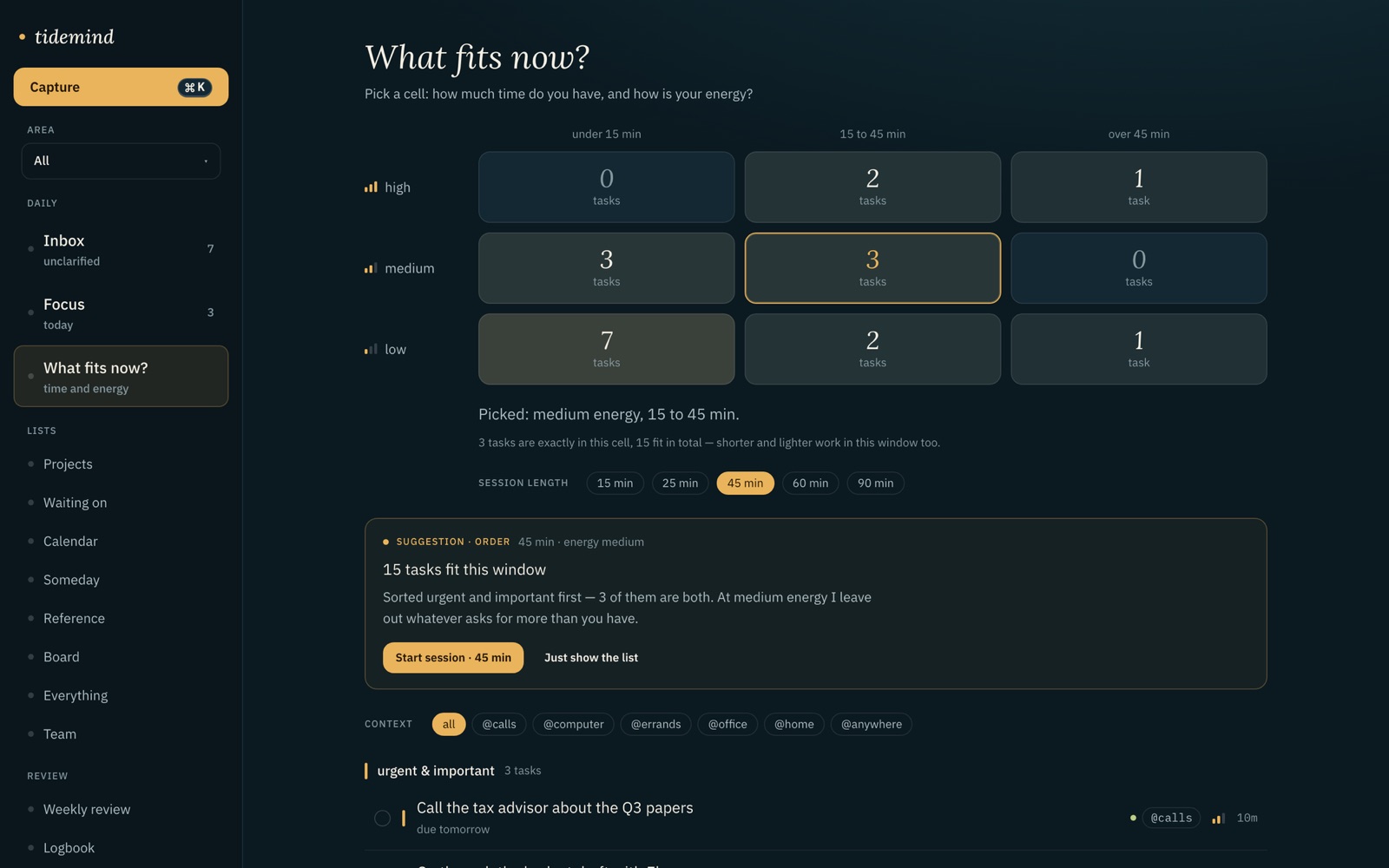
Less than in 2001, which is why time and energy do more of the filtering today. In tidemind the context is one of three parts of the question; minutes and energy are the other two. @computer with 15 minutes and low energy is a very different list from @computer with 90 minutes and a clear head.
Last updated:
Related pages
A context is a filter for the moment, not a folder.
Join the beta — freeFree while the beta runs · no card